

Evaluation process for major topics
- Identifying Stakeholders: Actron referred the AA1000SES Stakeholder Engagement Standard's five principles – Dependence, Accountability, Influence, Diversity of Perspectives, and Tension to identify six stakeholder groups as follow: employees, customers, suppliers, shareholders, government, and communities.
- Collecting Sustainability Issues: Actron gathered various sustainability issues from benchmark companies in domestic and international industries, insights from colleagues across departments, and interactions with stakeholders. The Corporate Sustainability Committee compiled these issues, and selected 22 sustainability topics for the scope of identification in the report and questionnaire survey.
- Analyzing Positive and Negative Impacts of Sustainability Issues: The Corporate Sustainability Committee and senior management conducted an impact assessment on the 22 sustainability issues, describing Actron's positive and negative impacts on the economy, environment, and people (including human rights) resulting from its operations and business relationships.
- Stakeholder Engagement Survey and Issues Impacts Interviews: The major topics of Actron are engaged every three years. In 2024, we relaunched a stakeholder survey to evaluate the impact level of various ESG sustainability issues. A total of 138 valid responses were collected. In addition to the survey, we conducted qualitative engagement through interviews with stakeholders to comprehensively assess the significance of each topic and its potential impact on Actron.
- Internal Impacts Assessment Survey: Actron invited members of its Corporate Sustainability Committee and management team to participate in an impact assessment questionnaire. This survey aimed to evaluate the actual or potential, positive or negative impacts, as well as the likelihood of occurrence, of various issues across the entire value chain, covering economic, environmental, social (including human rights), and company operational aspects. A total of 29 completed questionnaires were collected.
- Prioritizing the impacts: To more comprehensively assess the significance of each issue, we calculated the level of concern, the degree of positive and negative impact, and the likelihood of occurrence based on the aforementioned questionnaire. This allowed us to identify and rank the issues' impact significance, resulting in our materiality analysis. Through the quantitative analysis of the questionnaire results and discussions with the Corporate Sustainability Committee and internal experts from various fields, we selected eight priority major topics, all of which have a higher positive impact than negative. We also established management guidelines and objectives, which were reviewed and adjusted periodically. The material topics identified in 2024 showed slight differences compared to 2023 due to re-evaluation.
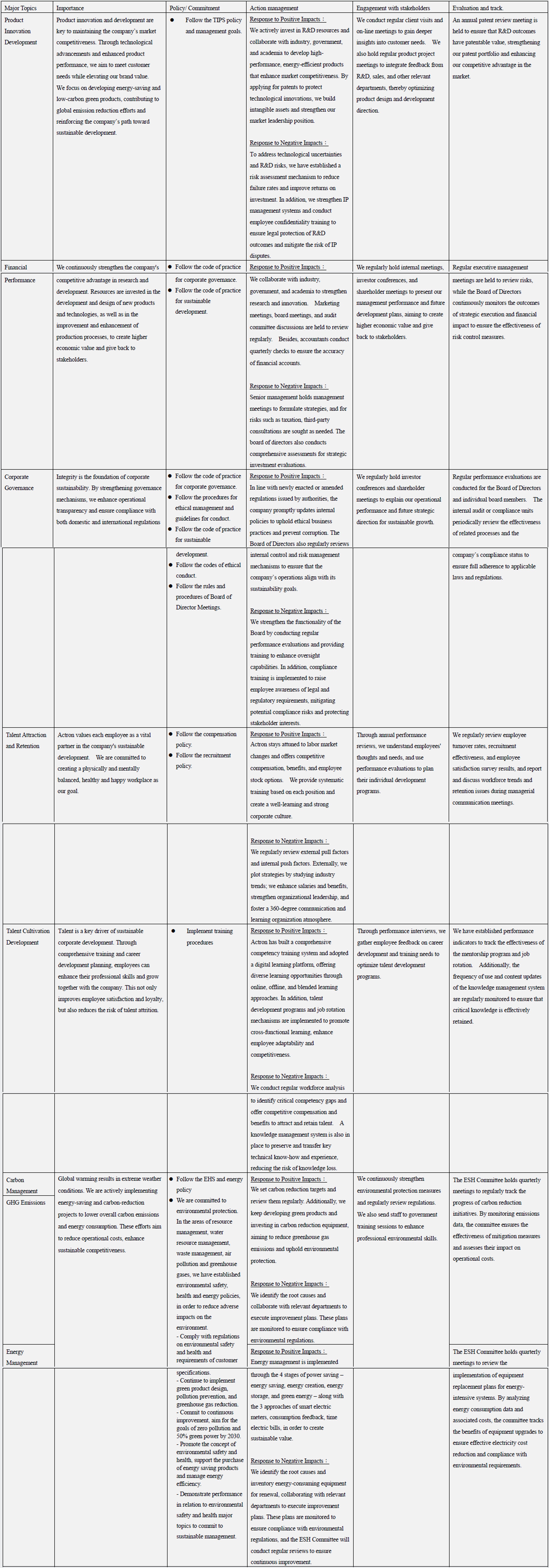
Management of Major Topics

Goals and Plans
| Major Topic | 2025 Goals | Performance Outcome | 2026 Goals | 2027-2030 Goals |
| Product Innovation Development | Proposal Statistics: A cumulative total of 6 proposals. |
A total of 6 items have been accumulated.
|
Proposal Statistics: A cumulative total of 6 proposals. | Proposal Statistics: A cumulative total of 10 proposals. |
| Product Innovation Development | The re-examination rate is below 20%. |
The re-examination rate was 15.3%
|
The re-examination rate is below 20% | The re-examination rate is below 15% |
| Financial Performance | Business operations with continuous profit |
|
Business operations with continuous profit | Business operations with continuous profit |
| Corporate Governance | Consistently ranked in the top 5% |
Ranked in tip 5% in consecutive 10 years(2016-2025)
|
Consistently ranked in the top 5% | Consistently ranked in the top 5% |
| Talent Attraction and Retention | The onboarding rate for indirect employee is ≥ 75% |
The onboarding rate for indirect employee was ≧95%
|
The onboarding rate for indirect employee is ≧75% | The onboarding rate for indirect employee is ≧80% |
| Talent Attraction and Retention | New employee (indirect) retention rate ≧80% |
New employee (indirect) retention rate ≧91.9%
|
New employee (indirect) retention rate ≧80%
|
New employee (indirect) retention rate ≧85%
|
| Talent Cultivation Development | The average annual training hours per employee should be ≧35 |
The average annual training hours per employee was ≧37.8
|
The average annual training hours per employee should be ≧35 | The average annual training hours per employee should be ≧40 |
| Talent Cultivation Development | A minimum course participation rate of 80% is required. |
A minimum course participation rate was 94%.
|
A minimum course participation rate of 80% is required. |
A minimum course participation rate of 80% is required. |
| Carbon Management GHG Emissions |
Reduce carbon emissions (total) by 20% (compared to the baseline year 2021)) |
The total carbon emissions reduced by 27.71%
|
Reduce carbon emissions (total) by 26%
(compared to the baseline year 2021) |
Reduce carbon emissions (total) by 50% (compared to the baseline year 2021) |
| Energy Management | Electricity unit consumption reduced by 20%
(compared to the baseline year 2019) |
Electricity unit consumption reduced by 62.31%
|
Electricity unit consumption reduced by 50%
(compared to the baseline year 2019) |
Electricity unit consumption reduced by 50%
(compared to the baseline year 2019) |